
 World Oceans Day: IOC in action to restore marine and coastal ecosystems in the Western Indian Ocean region
On June 8, we celebrated the World Oceans Day under the 2023 theme “Planet Ocean: A wave of action”, an opportunity to remember that without the oceans, we would not exist. Hence, the IOC is committed to make conservation and restoration actions in favor of the oceans a top priority.
In the South-West Indian Ocean region, researchers, communities, marine protected area managers, decision-makers, women, and young people are taking action to restore marine and coastal ecosystems.
Katia BALLORAIN, Doctor of Ecology, Project Manager for “Sea Turtle Ecology” at the Centre d’Étude et de Découverte des Tortues Marines (CEDTM), is one of the many people dedicated to the conservation of biodiversity and ecosystems.
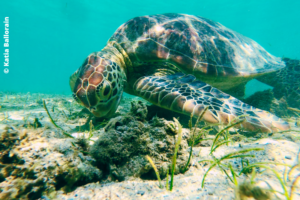
“Seagrass beds are important habitats for sea turtles. As such, I lead seagrass research and monitoring programs in the region,” she explains.
This passionate scientist decided to create the Western Indian Ocean Seagrass Network (WIOSN) in 2017, a platform made up of experts that facilitates the synergy of players around research on seagrass, monitoring, and conservation programs. “WIOSN’s main objectives are to strengthen regional cooperation among researchers and practionners, facilitate the exchange of information, build capacity and share experiences,” she adds.
The need to create this network arose from several observations. Firstly, the absence of a regional network dedicated to the topic, or a platform for exchanging information on seagrass beds (who does what? where?). Secondly, the variety of monitoring methods used and the need to standardise data to obtain a regional outlook on the status of seagrass beds. Finally, a need for filling knowledge gaps and sharing experiences at regional level.
“In 2017, I seized the opportunity of a seagrass monitoring project I was piloting (as part of the Best 2.0 scheme funded by the European Union) to organise a first regional workshop involving a representative of each geographical territory in the Western Indian Ocean region,” she explains.
“Today, the network’s main activities go beyond establishing links between stakeholders to include the development of a common protocol for monitoring seagrass beds and for the study of the specific richness of these beds through genetic analysis. Other activities should soon be carried out thanks to new regional initiatives such as the RECOS project run by the IOC and the WIOCOR project run by the IUCN,” asserts Katia BALLORAIN.
The network now includes about twenty members in ten countries (Comoros, France, Kenya, Madagascar, Mauritius, Mozambique, Seychelles, Somalia, South Africa, and Tanzania), but there is a growing need to structure and coordinate the network.
“The RECOS project provides invaluable support to WIOSN, facilitating synergy between programs aimed at conserving seagrass beds in the south-west Indian Ocean”, says Katia, before adding, “RECOS will in particular be able to contribute to the regional mapping of seagrass beds, an essential starting point for enabling the monitoring of these habitats and for easing the mapping of conservation issues”.
Last April, RECOS organised a workshop in the Seychelles on mangroves and seagrass beds key ecosystems. It enabled members of the WIOMN and WIOSN networks to exchange ideas on mangrove restoration methods and ecological monitoring of seagrass beds. Earlier this year in February, RECOS and the Varuna projects have joined forces to strengthen the WIOMPAN network through, among other things, a training on IMET (Integrated Management Effectiveness Tool), a tool that allows an in-depth assessment of marine and terrestrial protected areas.
***********************************************************************
Title: Journée mondiale des océans : la COI en action pour restaurer les écosystèmes marins et côtiers de la région océan Indien occidental
Content:
Le 8 juin, nous avons célébré la Journée mondiale des océans sous le thème « Planète Océan : Une vague d’actions » en 2023. L’occasion de rappeler que sans océans, l’humanité n’existerait pas. Par conséquent, prioriser les actions en faveur des océans et leur accorder toute l’attention qu’ils méritent sont plus que légitimes.
Dans la région du Sud-Ouest de l’océan Indien, chercheurs, communautés, gestionnaires d’aires marines protégées, décideurs, femmes et jeunes se mobilisent pour restaurer les écosystèmes marins et côtiers.
Katia BALLORAIN, Docteur en Ecologie, Cheffe de projets « Ecologie des tortues marines » au Centre d’étude et de découverte des tortues marines (CEDTM), fait partie de ces acteurs qui se consacrent à la conservation de la biodiversité et des écosystèmes.
« Les herbiers marins constituent des habitats importants pour les tortues marines. A ce titre, je mène des programmes d’étude et de suivi des herbiers marins dans la région » explique-t-elle par rapport à son intérêt vis-à-vis des herbiers.
Cette scientifique passionnée décide de fonder le réseau WIOSN (Western Indian Ocean Seagrass Network) en 2017, une plateforme composée d’experts qui facilite la synergie des acteurs autour de programmes d’étude, de suivi et de conservation des herbiers marins. « Les objectifs principaux du WIOSN sont de renforcer la coopération entre acteurs, de faciliter l’échange d’informations, et de renforcer les capacités et le partage d’expériences » précise-t-elle.
Le besoin de créer ce réseau est né de plusieurs constats. Tout d’abord, l’absence de réseau régional dédié à la thématique ou de plateforme d’échange d’informations sur les herbiers marins (qui fait quoi ? où ?). Ensuite, la variété des méthodes de monitoring utilisées et le besoin de standardiser les données pour obtenir une vision régionale de l’état de santé des herbiers. Enfin, l’existence de nombreuses lacunes de connaissances et la nécessité d’un partage d’expériences au niveau régional.
« En 2017, j’ai saisi l’opportunité d’un projet de suivi des herbiers marins que je pilotais (dans le cadre du dispositif Best 2.0 financé par l’Union européenne) pour organiser un premier atelier de travail régional auquel était invité un représentant de chaque territoire géographique de la région de l’océan Indien occidental » confie-t-elle.
« Aujourd’hui, au-delà de la mise en relation des acteurs, les principales activités du réseau sont l’élaboration d’un protocole commun de monitoring des herbiers marins et l’étude de la richesse spécifique de ces herbiers par analyse génétique. D’autres activités devraient prochainement être menées grâce à de nouvelles initiatives régionales telles que le projet RECOS porté par la COI ou encore le projet WIOCOR porté par l’UICN » affirme Katia BALLORAIN.
Le réseau compte maintenant une vingtaine de membres répartis au sein de dix pays (Afrique du Sud, Comores, France, Kenya, Madagascar, Maurice, Mozambique, Seychelles, Somalie, Tanzanie) mais les besoins en structuration et coordination du réseau sont croissants.
« Le projet RECOS apporte un soutien précieux au WIOSN en facilitant la synergie au sein des programmes visant la conservation des herbiers marins du Sud-Ouest de l’océan Indien » affirme Katia avant d’ajouter « RECOS pourra notamment contribuer à la cartographie régionale des herbiers marins, base nécessaire aux opérations de suivi de ces habitats et de cartographie des enjeux de conservation ».
En avril dernier, RECOS organisait aux Seychelles un atelier portant sur les écosystèmes essentiels que sont les mangroves et les herbiers marins. Il a permis à des membres des réseaux WIOMN et WIOSN d’échanger sur les méthodes de restauration de mangrove et de suivi écologique des herbiers marins.
Plus tôt dans l’année en février, RECOS se joignait au programme Varuna pour renforcer le réseau WIOMPAN à travers, entre autres, une formation IMET (Integrated Management Effectiveness Tool), un outil qui permet une évaluation approfondie des zones protégées marines et terrestres.