
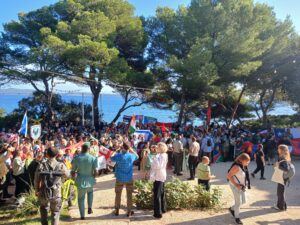
 Marine rangers play a pivotal role in safeguarding our oceans, yet their contributions often go unrecognized compared to their terrestrial counterparts. Addressing this gap was at the forefront during the “Professionalization and Recognition of Marine Rangers in the Western Indian Ocean (WIO) Region” session during the International Ranger Federation (IRF) World Ranger Congress, held in Hyères, France, from October 7–11, 2024.
WIOMSA and its partners, including WIOMPAN, led discussions emphasizing the critical need to empower marine rangers. With over 143 marine protected areas (MPAs) and 300+ community-managed areas (CMAs) covering 8% of the WIO region’s Exclusive Economic Zone, marine rangers are vital to achieving global conservation goals like the Kunming-Montreal Global Biodiversity Framework.
WIOMSA’s Marine Conservation Programme Manager, Deidre de Vos, called for greater investment in professionalizing marine rangers through specialized training, certification, career pathways, and regional collaboration. Arthur Tuda, WIOMSA’s Executive Director, highlighted how the Western Indian Ocean Certification of Marine Protected Area Professionals (WIO-COMPAS) continues to show promise in enhancing job satisfaction, boosting conservation outcomes, and increasing respect for marine rangers across the region.
Case studies from Seychelles and Mozambique further highlighted the transformative potential of professionalization. Certified rangers in Seychelles reported increased confidence, improved conservation skills, and stronger community engagement as noted by Mr. Allen Cedras, WIOMPAN President and Director of the Seychelles Parks and Garden Authority. Meanwhile, Ms Karen Allen, highlighted how Mozambique’s ambitious MPA expansion revealed urgent capacity gaps, prompting initiatives like a forthcoming Marine Conservation Leadership Academy to train future practitioners.
The session concluded with a call to action: expand certification programs, develop region-specific training, and advocate for formal recognition of marine rangers as essential conservation professionals. As highlighted by WIOMSA and WIOMPAN’s contributions to the session, empowering marine rangers strengthens biodiversity protection and supports coastal communities.