
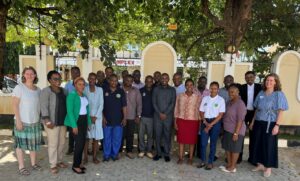
 Marine managers from Tanga Coelacanth Marine Park and Tanga Marine Reserves System trained in how to apply effective and adaptive management in a four-day workshop. This is the third Marine Protected Area location the Swedish Agency for Marine and Water Management has contributed with capacity building using the Conservation Standards as a method in Tanzania mainland.
TACMP, the Tanga Coelacanth Marine Park and the TMRs, Tanga Marine Reserves System have been operating for over ten years, covering a wide variety of rich biodiversity and important ecosystems, from coral reefs and sea grass beds to large stretches of mangrove forests. They are of prime significance in providing the local communities with food, climate resilience and livelihoods from tourism to mention some. The challenge is balancing the needs of the twenty-two villages along the 100 km stretch of coast with adequate conservation to maintain the functions of the valuable ecosystems and their associated marine and coastal species.
Ensure activities solve your challenges
The Tanga marine protection practitioners have gone through the capacity building workshop on effective and adaptive management arranged by SwAM, the Swedish Agency for Marine and Water Management. This was a great opportunity for the seventeen marine managers working both with the Tanga Coelacanth Marine Park that is co-managed with the communities living inside and from the marine resources and the management of the no-take reserves. The deeper understanding of how the management strategies are connected to the conservation impact and goals of the MPAs was valuable for the ten new recruits who joined the staff last year.
Many challenging questions were explored. Does our long-term vision of the park and current management strategies really lead to our ecological targets? How does the protection contribute to human well-being? Can we justify the park regulations and engage the communities nearby to support these?
“This was a timely workshop for our staff to kick start our process for the updating of the Tanga Coelacanth Marine Park General Management Plan” says Warden in Charge, Magreth Mchome.
“We will use the knowledge to review activities and objectives in our annual plans and budget to ensure that the activities developed solve the challenges or threats that occur in our MPAS.”
Smarter objectives and activities for effective results
Staff, especially new recruits, now understand better how to develop SMART objectives, and will be able to revise their activities to ensure that whatever is planned will lead to achieve the intended results.
The workshop also helped the Tanga team to identify the gaps, assess performance and how to adapt to better strategies to achieve the intended goals and objectives. The team expects to apply this knowledge when reviewing the TACMP General Management Plan during 2024.
Throughout the workshop there were tasks identified for the national MPRU headquarter to take leadership on. For example, finding a harmonised method for data collection, analysis and management across all the Tanzania network of MPAs. By the last day of the workshop, it also became clear that monitoring the health of the natural values, such as seagrass, be standardised at a national level similar to the coral reef monitoring that is undertaken across the WIO region.
Workshop part of a larger program
Annette Olsson from FOS Europe and Ottilia Thoreson from the Swedish Agency of Marine and Water Management facilitated the capacity building workshop on adaptive management during four days in Tanga, just south of the Kenyan boarder.
This is part of SwAM Ocean, the program financed by Sida, Swedish International Cooperation and Development Agency, that provides capacity building in design and management of marine conservation and protection, among other things. The program, which has now covered three of the four marine protected areas on the mainland Tanzania, provides the marine practitioners with a framework, structure and tools to assess if their MPAs are on track and how to apply an adaptive management approach to marine conservation.
Authors
Magreth Mchome, Warden in Charge at Tanga Marine Parks and Reserves and Maria Pentzel, Marine Conservation Warden at Marine Parks and Reserves Unit at national level & Ottilia Thoreson, the Swedish Agency for Marine and Water Management.
Contact us
Visit SwAM Ocean www.havochvatten.se/swam-ocean and Marine Parks and Reserves Tanzania www.marineparks.go.tz
For further information, please email jenny.hertzman@havochvatten.se or marineparks@marineparks.go.tz