
- Assessing and comparing the performance of Marine Protected Areas (MPAs) and Exclusive Economic Zones (EEZs) is necessary to inform conservation policy-making.
- MPAs and similar place-based tools for protecting marine biodiversity have ecological and social benefits only if fishing regulation, monitoring and enforcement are not undermined by political short-termism.
- Well-enforced EEZs also allow for effective governance and protection of marine resources.
View the paper details below
_________________________________________________________________________________________________________________
In the Pacific, the idea of protecting certain areas is anchored in the ancient notion of sacred sites, “tapu” areas, a traditional Polynesian concept. Over the last century, this idea has evolved. It is now globally accepted, modified and implemented under the concept of Marine Protected Areas (MPAs). Many governments have scaled up their ambitions and efforts to achieve environmental protection targets, including protecting as much 10% of their waters by 2020 or 30% by 2030 – a target that is presently out of reach. With 7.7 % of the ocean protected, the 2020 target has de facto been missed. Currently, only 2.7% of the ocean is fully or highly protected from fishing impacts. As The MPA Guidehighlighted, quantifying how much of the ocean’s biodiversity is effectively protected is challenging, but we are closer to connecting MPA science to policy and action.
In practice, well-managed MPAs do not only conserve nature, but also contribute economic, recreational and cultural value to society by sustainably providing crucial ecosystem services, including biodiversity, food security and carbon storage.
However, countries also have the possibility of utilizing their Exclusive Economic Zone (EEZ) as a tool to protect and manage marine resources. Coastal states can claim an EEZ that extends to 200 nautical miles off their shores (see United Nations Convention on the Law of the Sea, UNCLOS).
In my latest paper (Relano et al., 2021), I compare the performance of four Large Scale Marine Protected Areas (Hawaii, Galapagos, New Caledonia, Pitcairn) in regards to fishing intensity for different commercial marine species, using the historical catch reconstructions of exploited taxa from 1950 to 2018, as calculated by the Sea Around Us.
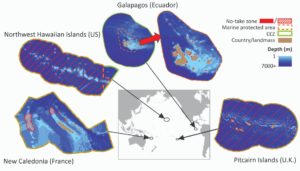
Figure 1 – The four study sites studied with information on EEZ and MPAs and their no-take borders. Source
Assessing performance of Marine Protected Areas
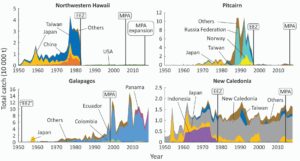
Similarly, the declaration of the MPA had no noticeable effect on the catch around the Pitcairn Islands (Figure 3B) and New Caledonia (Figure 3C), albeit for different reasons. In the Pitcairn Islands (MPA established in 2016), foreign fleets were already absent since the declaration of the EEZ in 1997. On the other hand, in New Caledonia, the establishment of an MPA in 2014, covering almost the entire EEZ, was not accompanied by any measures designed to limit fishing operations in what is supposed to be the “Parc Naturel de la Mer de Corail.” Indeed, fishing effort increased in the ‘Parc Naturel’ since its declaration.
It is in the Galapagos Archipelago (MPA established in 1998) where the situation is most complex (Figure 3D). Even though the no-take areas only occupy 1 % of the MPA (or 0.2 % of the EEZ), the lack of consultation and participation of the small-scale fishers during the MPA creation has led to many disputes. As a result, conservation efforts had little support on the island. This is despite Galapagos’ dependence on tourism, which itself depends on a healthy marine ecosystem.
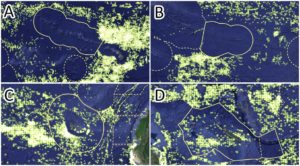
Figure 3 – Fishing by recorded vessel effort in the four study sites: (A) Northwest Islands of Hawaii, (B) Pitcairn, (C) Galapagos and (D) New Caledonia. The yellow dots and the color intensity reflect the fishing effort in a specific place.Source
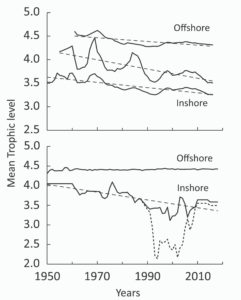
Fishing down marine food webs
Fishing the line
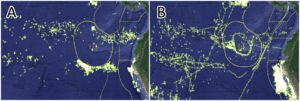
Figure 5 illustrates two levels of ‘fishing the line’ around the Galapagos Islands. The first level is represented by non-Ecuadorian vessels fishing at the southern edge of the Galapagos EEZ (Figure 5A).
Operations of this sort by a Chinese squid fleet were the subject of intense, negative press coverage. Figure 5B documents fishing at the edge of the Galapagos LSMPA, i.e., within the Galapagos EEZ, by Ecuadorian vessels and vessels from other countries presumably with agreements to access the Galapagos EEZ.
Also note that the non-occurrence of fishing the line does not necessarily imply that a marine reserve or MPA was badly designed because it does not generate ‘spill-over’. Rather, it may be due to the border area of the marine reserve or MPA being less productive or not including desired habitats. For example, spill-over around the Papahānaumokuākea Marine National Monument is not expected as there are no nurseries or spawning grounds around the LSMPA for the target species of the Hawaiian longline fishery.
Take-away
We show that well-enforced EEZs allow for effective governance and protection of marine resources. In Pitcairn and the Northwest islands of Hawaii, the establishment of EEZs had a strong effect on fisheries, directly and substantially reducing foreign industrial fishing. Therefore, the subsequent impact of the LSMPA establishment on catch was very small in both Northwestern Hawaii and Pitcairn.
In New Caledonia and the Galapagos Islands, the EEZ implementation resulted in foreign fleets being replaced by a local industrial fleet. In New Caledonia, the subsequent designation of the entire EEZ as a huge MPA, the ‘Parc Naturel de la Mer de Corail’, had no effect whatsoever on catch, because it is in effect a ‘paper park’, involving no restrictions on the operation and growth of the local industrial fishery.
In the end, it is not so much about the kind of legal designation of an area that determines successful conservation of the ecosystems in it, but rather about the appropriate institutional, legal and technical capacity that need to come together to design, monitor and enforce protection of marine biodiversity.