Nine Ocean Conservation Areas (OCAs) across the Western Indian Ocean (WIO) have been selected to join the next phase of the Hifadhi Blu Programme, marking an important milestone in a regional effort to strengthen the effectiveness of marine conservation management.
Implemented by WIOMSA in partnership with Advanced Conservation Strategies (ACS), with support from the Minderoo Foundation, Hifadhi Blu was established to address one of the greatest challenges facing marine conservation today: ensuring that OCAs are not only designated, but effectively managed.
Across the WIO region, governments and communities have made significant progress in expanding marine conservation. Yet, as highlighted in the Western Indian Ocean Marine Protected Areas Outlook, many OCAs continue to face common challenges that limit their long-term effectiveness, including constrained institutional capacity, fragmented governance, limited financial resources, weak monitoring systems, competing stakeholder interests and increasing pressures from climate change and unsustainable resource use. Improving management effectiveness therefore requires more than implementing individual conservation activities – it requires strengthening the systems that enable conservation to succeed.
Following a competitive regional call for proposals, nine sites from Kenya, Tanzania, Mozambique, Madagascar, Seychelles, Mauritius (Rodrigues), Somalia and South Africa were selected to join the programme. Together, they represent the diversity of OCAs found across the region, from nationally managed Marine Protected Areas (MPAs) and a globally significant World Heritage Site to Joint Co-Managed Areas and Locally Managed Marine Areas. While each site operates within a unique ecological and governance context, many share common barriers to effective management, making them ideal candidates for testing new approaches to strengthening conservation systems.
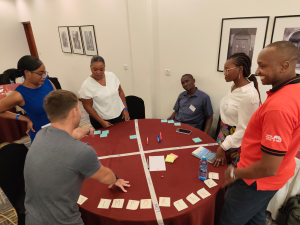
To better understand these challenges, each grantee participated in a Collaborative Systems Workshop facilitated by WIOMSA and ACS. Project teams worked together to map the ecological, institutional, governance and social systems influencing management effectiveness within their sites. By examining how these different components interact, participants were able to identify the underlying drivers of management challenges and prioritize interventions capable of creating meaningful and lasting change.
A phased approach builds strong foundations before scaling up
One of the key innovations emerging from this process is the adoption of a phased implementation approach for several sites. Instead of implementing all proposed activities simultaneously, Phase 1 focuses on strengthening the enabling conditions for effective management. Depending on the needs of each site, this may include improving governance arrangements, strengthening monitoring and data systems, building institutional capacity, enhancing stakeholder participation, or developing better mechanisms for adaptive decision-making. Larger interventions will then build on these stronger foundations as implementation progresses.
In Kenya, projects will strengthen collaborative governance within the Malindi-Watamu MPA and the Shimoni-Vanga and Malindi-Magarini Joint Co-Managed Areas. Tanzania and Mozambique will focus on strengthening community-led governance and sustainable fisheries management. Madagascar’s Nosy Hara Marine National Park will enhance management systems within one of the region’s most important protected areas, while the Seychelles Islands Foundation will continue strengthening the effective management of the globally recognized Aldabra Atoll. In Rodrigues, efforts will focus on improving institutional coordination and management systems within the South East MPA, while Somalia’s Baraawe Marine Conservation Area represents an important opportunity to establish the governance and management foundations needed to support the first Ocean Conservation Area in Somalia. In South Africa, the Eastern Cape Parks and Tourism Agency will strengthen governance and operational management within the Dwesa-Cwebe MPA.
Tracking system strength, not just activity, throughout implementation
Throughout implementation, monitoring will extend beyond tracking activities and outputs to assessing whether the management systems themselves are becoming stronger. Sites will monitor changes in governance, institutional capacity, stakeholder engagement, ecological monitoring, compliance systems, decision-making processes and the use of evidence to inform management.
Through technical exchanges, peer learning and regional collaboration, grantees will share experiences, test new approaches and contribute to a growing body of knowledge on what enables effective marine conservation across the WIO region.
Ultimately, the success of Hifadhi Blu will be measured by what remains after the programme concludes. Stronger governance systems, better-informed decision-making, improved monitoring frameworks, capable management teams, lasting institutional partnerships and a culture of adaptive learning are intended to endure well beyond the life of the grants.
Hifadhi Blu grantees
- Kenya:Malindi-Watamu MPA – A Rocha Kenya and Bahari Hai
- Kenya:Shimoni-Vanga and Malindi-Magarini Joint Co-Managed Areas – Kenya Fisheries Service
- Tanzania:Dokichunda Collaborative Fisheries Management Area – WATONET
- Mozambique:Vamizi Locally Managed Marine Area – Quirimbas Foundation
- Madagascar:Nosy Hara Marine National Park – Madagascar National Parks
- Mauritius (Rodrigues):South East MPA – Rodrigues Regional Assembly
- Seychelles:Aldabra Atoll – Seychelles Islands Foundation
- Somalia:Baraawe Marine Conservation Area – Climate Resilience and Adaptation Network
- South Africa:Dwesa-Cwebe MPA – Eastern Cape Parks and Tourism Agency